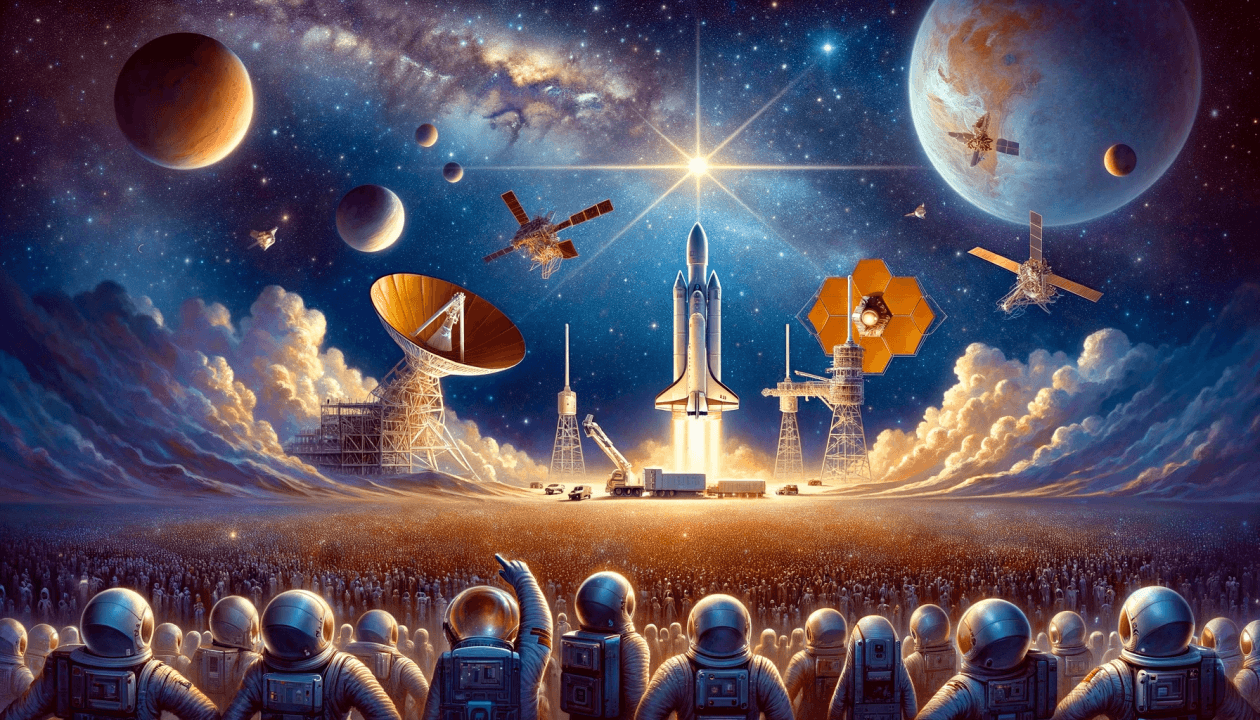
1. Launching Humanity into Space: Advancements in rocketry and launch technology have enabled unprecedented access to space. Companies like SpaceX, Blue Origin, and Rocket Lab are driving innovation in reusable rocket systems, significantly reducing the cost of space launches. Heavy-lift rockets like SpaceX's Falcon Heavy and NASA's Space Launch System (SLS) pave the way for ambitious missions to the Moon, Mars, and beyond. Additionally, advancements in propulsion systems, such as ion engines and nuclear propulsion, promise faster and more efficient interplanetary travel.
2. Revolutionizing Earth Observation with Satellites: Satellite technology has transformed our understanding of Earth and revolutionized industries ranging from telecommunications and navigation to agriculture and environmental monitoring. Constellations of small satellites provide real-time Earth observation data, enabling applications like weather forecasting, disaster response, and precision agriculture. High-resolution imaging satellites capture detailed imagery of Earth's surface, facilitating urban planning, resource management, and environmental conservation efforts.
3. Unraveling the Mysteries of the Cosmos: Space exploration missions continue to push the boundaries of human knowledge and inspire awe and wonder. Robotic probes and landers explore distant worlds, such as Mars, Venus, and the outer planets, uncovering clues to the origins of the solar system and the potential for life beyond Earth. Ambitious missions like NASA's James Webb Space Telescope promise to revolutionize our understanding of the cosmos by peering into the depths of space and time, observing distant galaxies, exoplanets, and the cosmic microwave background radiation.
4. Commercializing Space: The burgeoning space tourism industry is making space travel more accessible to private individuals. Companies like SpaceX, Virgin Galactic, and Blue Origin are developing spacecraft and launch systems for suborbital and orbital space tourism flights. Commercial ventures in space mining and manufacturing hold the promise of unlocking the vast resources of the solar system, including rare metals, water ice, and helium-3. Moreover, the International Space Station (ISS) serves as a platform for scientific research and commercial activities in microgravity environments.
5. Space Sustainability and Exploration Ethics: As humanity ventures further into space, it must confront challenges related to space debris, orbital congestion, and the preservation of celestial environments. Sustainable space exploration practices, including debris mitigation measures and responsible resource utilization, are essential for ensuring the long-term viability of space activities. Ethical considerations surrounding planetary protection, cultural heritage sites on celestial bodies, and the potential for extraterrestrial life require careful deliberation and international cooperation.
Conclusion: Space technology represents humanity's quest to explore, understand, and ultimately thrive beyond the confines of Earth. As technological advancements accelerate and space becomes more accessible, the possibilities for scientific discovery, economic development, and human expansion in space are virtually limitless. By embracing the spirit of exploration, collaboration, and responsible stewardship, humanity can chart a course towards a future where the cosmos becomes our next frontier.